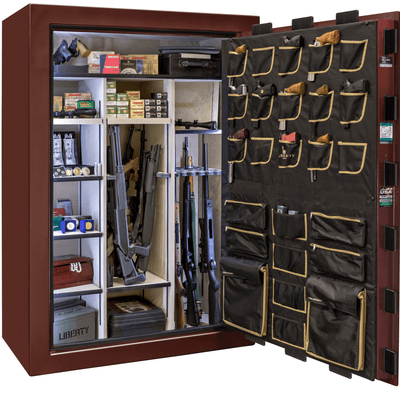

What is the Best Liberty Safe Fireproof Gun Safe?
- Is any gun safe truly fireproof?
- How Liberty tests its fire ratings
- Do fireproof gun safes actually work in a real house fire?
- Three things that decide whether a safe survives
- Liberty Safe fire ratings by series
- Which fire rating do you actually need?
- Where you put the safe changes the outcome
- What a fire rating doesn't cover
- Frequently asked questions
- The short version
Updated: August 2026
I've been delivering and installing safes for The Safe Keeper for more than ten years, and I've spent most of that time in Las Vegas. In that stretch I've moved a few thousand safes into homes, and I've also been called out to open safes that came out of houses that burned down. Those second calls taught me more about fire protection than any spec sheet ever did.
Here's the thing most buyers don't realize: two safes can both be labeled "fireproof" and behave completely differently in an actual fire. The label isn't the story. The test behind it is, along with how the safe is built and where it ends up sitting in your house.
This guide walks through how fire ratings work, which Liberty series offer what, and what I've seen hold up when the fire department finally puts it out.
Is any gun safe truly fireproof?
No. And any dealer who tells you otherwise is selling you something.
Steel doesn't stop being steel at 1,400°F, it just softens. Every safe on the market is fire resistant for a defined stretch of time at a defined temperature. "Fireproof gun safe" is the phrase everyone searches for, so it's the phrase everyone uses, but the honest term is fire rated.
That distinction matters because a lot of budget safes claim fire protection with nothing behind the claim. The manufacturer ran its own test, wrote its own number, and printed a sticker. There's no legal requirement to verify it. A fire rating only means something when the test protocol is disclosed and follows an established standard.
Liberty builds its fire testing around research from the U.S. Department of Commerce National Institute of Standards and Technology on what a full-scale house fire actually does. That's the reference point I trust, and it's why I can tell a customer what a 90-minute rating means without hedging.
How Liberty tests its fire ratings
A fire rating has two numbers in it, not one. The rating is only meaningful if you know both.
The first is the external temperature. Liberty tests at 1,200°F, which reflects what NIST measured in real residential fires. The second is the interior ceiling: the inside of the safe has to stay under 350°F for the full duration. That 350°F figure comes from paper. Paper chars around 400°F, so 350 is the threshold where documents, cash and photographs come out readable.
So when a Liberty safe is rated 90 minutes, it means the safe sat in a 1,200°F furnace for 90 minutes and the interior never crossed 350°F.
The furnace ramp trick
This is the part I wish more buyers knew about, because it's where competing numbers stop being comparable.
NIST data shows a house fire hits roughly 1,200°F within the first several minutes. Liberty ramps its furnace to 1,200°F in about ten minutes and holds it there for the whole test. A 60-minute rating means roughly 50 minutes of actual full-temperature exposure.
Some manufacturers ramp slowly on purpose. They take 20, 30, sometimes 40 minutes to reach 1,200°F, then stop the clock at 60 minutes and print "60-minute fire rating." The safe only saw peak heat for 20 minutes. Same sticker, a third of the exposure.
If you're comparing two brands and only one publishes its ramp time, you already have your answer.
Do fireproof gun safes actually work in a real house fire?
Yes, within their rating, and I've seen the evidence firsthand more than once.
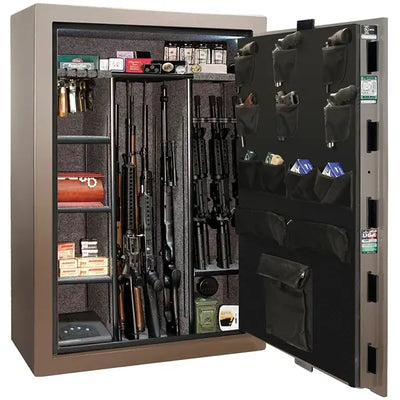
The most instructive one I've dealt with was a total loss in the northwest valley. The house burned long enough that the roof came down. The safe was a Liberty in the 90-minute range, bolted to a concrete slab in a ground-floor closet. When we got it open, the finish was gone and the paint had cooked off the door, but the rifles inside were fine. Wood stocks were intact. Some of the paper in the door panel had yellowed. The owner got his collection back.
I've also seen the other outcome. A safe in an attached garage, unbolted, rated at 30 minutes, in a fire that ran long. The door seal did its job for as long as it was designed to, and then it stopped. Everything inside was scorched.
Neither result was a surprise. The first safe was rated for the fire it got and placed somewhere that bought it extra time. The second wasn't and wasn't.
A few patterns I've noticed across the ones I've opened:
- Firearms usually survive better than people expect. Barrels and actions come through heat far better than the finish does. Refinishing is common. Total loss is less common than you'd think.
- Optics and electronics are the first casualties. Scopes, red dots, thermal units, and anything with a battery or adhesive lens bond suffer well before the 350°F line.
- Water does damage after the fire is out. More on that below.
- Cheap safes fail at the door, not the walls. Almost every failure I've seen started with the door gap.
Three things that decide whether a safe survives
When I'm asked what separates a real fire rated gun safe from a decorated metal cabinet, it comes down to three things. All three are visible on a spec sheet if you know where to look.
1. Steel thickness and weld count. The body is your heat barrier and your structural integrity. Thin steel warps under heat, and once the body warps the door gap opens. Every weld is a potential path for heat and smoke. Fewer welds and thicker plate means the box holds its shape longer. Liberty's Presidential and Magnum bodies use 7-gauge steel, which is roughly three times thicker than what you find on entry-level safes from other brands.
2. The door seal. This is the single most important component and the one buyers pay the least attention to. Liberty uses a heat-activated Palusol seal that expands to about seven times its size at around 212°F and holds that expanded form well past 1,200°F. It swells into the door gap and blocks the smoke and superheated air that would otherwise pour in around the edges. Smoke damage is what ruins collections in safes that technically "survived."
3. Layered fire board, tightly joined. Walls, ceiling, floor and door all need fire-rated board, and the seams between panels matter as much as the number of layers. A gap at a seam is a heat channel. Liberty's higher series use a full sealed enclosure they call the Cool Box, where the board wraps the interior rather than sitting in separate panels.
Miss any one of the three and the rating on the sticker doesn't mean much.
Liberty Safe fire ratings by series
Every Liberty rating below is measured at 1,200°F with a 350°F interior ceiling. Ratings are current as of 2026, and Liberty does revise them, so confirm the label on the specific model you're looking at.
| Series | Fire rating | Best suited for |
|---|---|---|
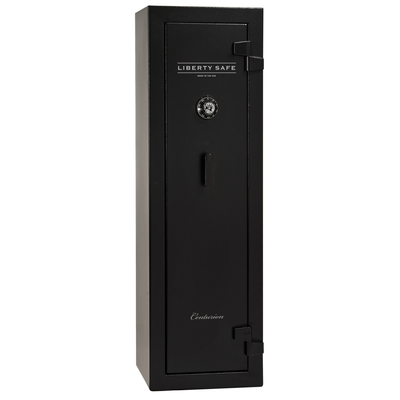
| Centurion (12, 18) | 30 minutes | First safe, small collection, tight budget |
| Centurion (24, 32) | 40 minutes | Growing collection, entry-level protection |
| USA | 60 minutes | The practical baseline for most homes |
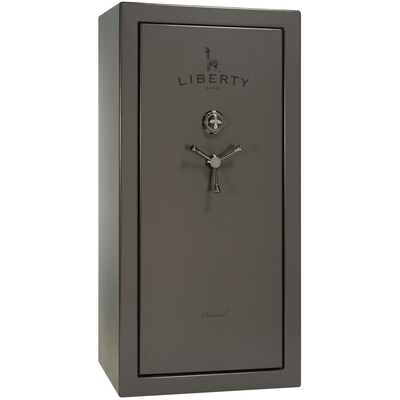
| Colonial | 75 minutes | Strong protection without a premium price |
| Franklin | 110 minutes | Serious collections, Cool Box construction |
| Lincoln | 120 minutes | 2 hour fire rated gun safe, heirloom build |
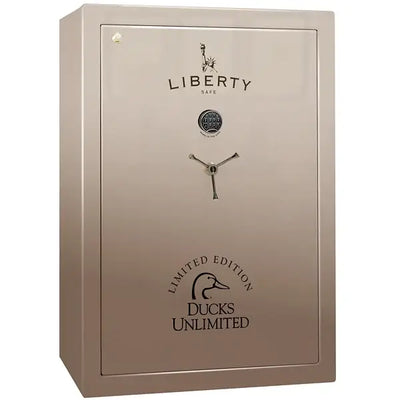
| Presidential | 150 minutes | Top-tier fire and security, 7-gauge body |
| Magnum | 150 minutes (2.5 hours) | Longest rating Liberty offers, 7-gauge body |
Two notes worth flagging.
First, Presidential and Magnum carry the same fire rating. 150 minutes and "2.5 hours" are the same number written two ways, and I've had customers assume Magnum was somehow longer. It isn't. The two lines differ in security features, door construction and finish, not in fire duration. Choose between them on locking hardware and budget, not on fire.
Second, if you're looking at an older Freedom series Liberty on the used market, check the physical label on the safe. Those ratings were generally in the 30 to 40 minute range, and the lineup has been reorganized since. Don't assume based on a name.
Which fire rating do you actually need?
I get asked for "the best fireproof gun safe" constantly, and the honest answer is that it depends on your house more than your collection.
Sixty minutes is the sensible floor. Below that you're covered for a kitchen fire that gets caught fast, and not much else. If your budget only reaches a 30 or 40 minute Centurion, buy it anyway, since it beats a locked closet by an enormous margin. Just know what you have.
Ask how far you are from a fire station. This is the question almost nobody asks and it's the most useful one. In parts of the Las Vegas valley, response time is four to six minutes. In outlying areas it can be fifteen or twenty, and rural properties are longer still. Then add suppression time. A long response plus a wood-frame house is the case for 90 minutes or more.
Match the rating to what's irreplaceable. If the safe holds hunting rifles you could replace with an insurance check, 60 to 75 minutes is reasonable. If it holds an inherited collection, original paperwork, or engraved pieces that can't be replaced at any price, go to 110 minutes or beyond. Insurance replaces value, not history.
Rough guidance from what I see people actually buy and stay happy with:
- First safe, modest budget: Centurion 24 or 32, or a Revere. 40 minutes, solid entry point.
- Best overall value: Colonial at 75 minutes. This is the one I recommend most often. The jump from 60 to 75 minutes costs very little and covers a meaningfully worse fire.
- Serious collection: Franklin at 110 minutes or Lincoln at 120.
- Maximum protection: Presidential or Magnum at 150 minutes.
Where you put the safe changes the outcome
Here's the part that gets left out of nearly every fireproof gun safe article, and it's the part I'm most qualified to talk about, because placement is my actual job.
Two identical safes in the same fire can produce different results based on nothing but which room they're in. Fire ratings are lab numbers. Your house is not a lab.
Ground floor beats upper floor. Heat rises, and upper living spaces burn hotter. A second-floor safe also has a real chance of falling through a weakened floor into the fire below, which puts it under debris and extends its exposure well past the rating. I've delivered plenty of safes upstairs and I'll do it when a customer wants it, but I tell them what they're accepting.
Interior walls beat exterior walls. Interior walls take longer to reach ignition temperature. A safe tucked against an interior wall in a ground-floor closet is in the slowest-burning part of most homes.
Concrete slab beats framed floor. A slab doesn't burn and doesn't collapse. It also solves your weight problem. A loaded Magnum runs well over a thousand pounds.
Attached garages are the worst common choice. They're usually the first area to go, they're loaded with fuel like vehicles, fuel cans, paint and solvents, and they burn hot. Garages also cycle through big temperature and humidity swings year-round, which is hard on firearms even with no fire involved. If the garage is your only option, put the safe in the corner farthest from the house, bolt it down, and consider framing a closet around it.
Bolt it down. Anchoring is a burglary measure first, but it matters in fire too. A safe that tips or falls during a structural collapse can land door-down or take impact on a seam, and both make recovery worse. Four anchors into concrete takes twenty minutes.
If you're weighing a longer fire rating against a better location, take the better location. Moving the safe to a ground-floor interior closet often buys you more real-world protection than upgrading one tier.
What a fire rating doesn't cover
A fire rating covers one thing: interior temperature over time. Plenty of damage happens outside that scope.
Water. Fire departments use a lot of it, and it goes exactly where the fire was. A fire seal is designed to keep heat and smoke out, not standing water. If your safe holds documents, cash, drives or currency, put them in a sealed waterproof container inside the safe. That's a five-dollar fix for a very expensive problem, and I've watched people learn it the hard way.
Humidity, long term. Not a fire issue, but the most common damage I see. Sealed safes trap moisture. Put a dehumidifier rod or desiccant in it, especially in a garage or basement.
Ammunition. Stored ammunition can cook off well below the temperatures a fire safe is designed to resist, and it's not something manufacturers test for. I'd keep bulk ammo separate from the safe holding your firearms.
Digital media. The 350°F interior standard is calibrated for paper. Hard drives, SSDs and film start degrading closer to 125°F. If you're storing drives or backups, they need their own media-rated container inside the safe.
Smoke, if the seal fails. A safe can hold temperature and still let smoke in through a compromised gap. This is the failure mode that makes a good door seal worth paying for.
Frequently asked questions
Do fireproof gun safes actually work?
Yes, within their rating and their limits. A fire rated safe that gets a fire shorter than its rating usually protects its contents well. The same safe in a longer or hotter fire will eventually let heat through. The rating is a promise about a specific duration at a specific temperature, not a guarantee against any fire.
Which gun safe has the longest fire rating?
Among Liberty's lineup, the Presidential and Magnum series both carry 150 minutes at 1,200°F, which is 2.5 hours. That's the longest Liberty offers. Across the broader market a few manufacturers advertise longer numbers, but check the test protocol before comparing, since ramp times vary significantly between brands.
Are gun safes fireproof and waterproof?
Very few gun safes are genuinely waterproof, and most fire rated gun safes aren't. Fire seals block heat and smoke; they aren't designed for submersion or sustained water exposure from firefighting. Use waterproof containers inside the safe for anything water-sensitive.
Will paper money burn in a fireproof safe?
Paper chars around 400°F, which is why fire ratings hold the interior under 350°F. Inside the rated duration, cash and documents normally come out intact. Past the rated duration, all bets are off. Water damage after the fire is a bigger risk to cash than heat, in my experience.
What's the difference between a 60 minute and a 90 minute fire rated gun safe?
More insulation, usually thicker steel, and often a better door seal. Practically, it's thirty extra minutes at 1,200°F, which can be the difference between a fire that's contained quickly and one where the structure collapses before crews finish. If your fire response time is long, the upgrade earns its cost.
What gun safes should I avoid?
I'd be cautious with any safe that lists a fire rating without naming a temperature, a duration, and a test standard. Also be careful with thin-gauge bodies, ratings that seem out of line with the price, and thin sheetrock insulation with visible seams. A fire rating you can't verify isn't a fire rating.
Does a small fireproof gun safe protect as well as a full-size one?
Not usually. Smaller safes have less material and often a shorter fire rating. A small fireproof gun safe is a good option for a handgun or documents, but if you're protecting a collection, size and rating tend to move together.
Do I need to bolt down a fire rated safe?
Yes. It's primarily theft prevention, since an unanchored safe can be tipped and carried, but anchoring also keeps the safe stable if the structure around it fails during a fire. It takes a short time and it's part of every install we do.
The short version
Fire protection is the second reason most people buy a safe, right behind burglary, and it's the one buyers understand least. The number on the sticker only means something when you know the temperature it was tested at, how fast the furnace got there, and how long it stayed.
Liberty publishes all three, and its ratings are built on NIST research into real house fires. That's the reason I've been comfortable recommending them for the past decade. The range runs from 30 minutes on an entry-level Centurion up to 150 minutes on a Presidential or Magnum, with the Colonial at 75 minutes hitting the value sweet spot for most homes.
Then make sure it lands somewhere worth putting it. Ground floor, interior wall, concrete if you have it, bolted down. That decision is free, and I've watched it matter more than one tier of fire rating.
Written by