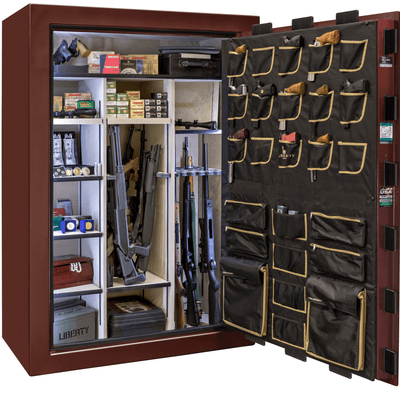

Are Liberty Safes Good?
- The short answer
- What "Made in the USA" actually means here
- How Liberty builds a safe
- Liberty's security levels, decoded
- Fire protection: what the ratings mean
- The warranty, including the fine print
- Which Liberty series fits which buyer
- Where Liberty isn't the right pick
- The part nobody asks about: installation
- So, are Liberty safes good?
- FAQ
Updated: August 2026
The short answer
Yes, with conditions attached.
I've spent more than ten years at The Safe Keeper, and a large share of that time has been on the delivery truck or on a customer's garage floor with a hammer drill. I've moved Liberty safes into second-floor bedrooms in Summerlin, pulled them out of houses after fires, and taken plenty of service calls when a lock stopped cooperating. That's a different vantage point than a spec sheet gives you.
What I can tell you is that Liberty builds a consistent product at almost every price point, backs it with the strongest fire and burglary warranty in the category, and makes its full-size safes in Utah. That combination is real, and it's why the brand sells as well as it does.
What I'd also tell you, sitting across from you at the showroom, is that the entry-level Liberty models are entry-level for a reason, gun safe fire ratings across the whole industry are looser than most buyers assume, and a great safe installed badly is a worse purchase than a mid-tier safe bolted down correctly. Those caveats matter more than the badge on the door.
What "Made in the USA" actually means here
Liberty's full-size gun safes, home safes and vault doors are built in Payson, Utah, at a plant of roughly 300,000 square feet with more than 300 employees. It's the largest safe manufacturing operation in the country. American steel, American labor, and a single facility where the welding, fireboard installation, painting and assembly all happen under one roof.
Two things I'd add that Liberty's own marketing tends to skip.
First, Liberty is not the only American-made option. Fort Knox has built safes in Orem, Utah since 1982. Browning's ProSteel line is made in Provo. If domestic manufacturing is your deciding factor, you have more than one shortlist candidate.
Second, "Liberty" as a brand covers more than the Payson-built lineup. Smaller products, some accessories, and certain budget-tier items sold under Liberty or its sister brands may be sourced differently. If US manufacturing is the point, confirm it on the specific model number you're buying, not the brand as a whole. Every Payson-built safe carries the marking, and any honest dealer will tell you straight.
Why does the single-plant setup matter in practice? Parts availability. When a customer calls me about a broken handle or a bent shelf clip on a safe from 2014, Liberty can usually source it. Brands that shifted production between overseas contract factories often can't.
How Liberty builds a safe
Steel gauge, and why the number misleads people
Gauge runs backwards from what you'd expect. A lower number means thicker steel. Liberty's budget line uses 14-gauge body steel, the mid-range uses 12-gauge, and the top tier moves to 7-gauge.
The jump from 14 to 12 is bigger than it sounds. Twelve-gauge steel is close to twice as strong as 14-gauge against a pry bar. Seven-gauge is in a different category entirely and is also the reason a Presidential-series safe can weigh well over a thousand pounds.
Here's the practical version, based on what actually happens in break-ins I've heard about from customers and locksmiths: most residential burglars aren't cutting a safe open. They're prying at the door seam with whatever's in the garage, or they're taking the whole safe out the door. Thicker body steel helps with the first problem. Bolting down handles the second. Body steel below 12-gauge is fine for casual protection but it won't survive a determined effort with a long pry bar.
Locking bars instead of round pins
Liberty uses flat locking bars roughly four inches wide rather than the round pins you see on a lot of imported safes. The wider contact surface spreads out prying force instead of concentrating it on a small round point. On the higher levels, those bars sit behind a hardened plate that protects the lock body from drilling and from punch attacks on the dial.
This is one of the areas where the difference between brands is genuinely visible if you open a door and look at the mechanism. I encourage customers to do exactly that in the showroom.
Dial or electronic lock
Liberty offers both a mechanical dial and an electronic keypad, and buyers ask me which is better almost every day.
Electronic locks are faster, and if you want quick access under stress that speed counts. They also fail eventually. A keypad is an electronic component, and after eight or twelve years I get calls. Replacement is straightforward and not expensive, but it's a service call.
Mechanical dials are slower and take practice, but a quality Group 2 dial can run for decades with nothing more than an occasional cleaning. I run a dial on my own safe. I recommend electronic to most customers with kids in the house, because access speed matters more there than longevity.
Liberty's security levels, decoded
Liberty rates its full-size safes on a numbered security scale. The rating pulls together six things: body steel thickness, third-party certification, door construction, the locking mechanism, locking bar thickness, and the type of lock guard behind the dial.
That single number is useful shorthand, but read what's behind it. Two safes at adjacent levels can differ mostly in door construction while the body steel stays the same, and door construction is where a lot of the cost sits.
On certification: Liberty's safes across the security levels are approved by the California DOJ as firearm safety devices, and the mid and upper levels carry UL Residential Security Container (RSC) certification. RSC is a real, tested standard. A UL technician attacks the safe with hand tools for a set period. It's also a modest bar, five minutes of attack time with common tools in its base form, so treat it as a floor rather than a ceiling. Any brand claiming a safe is "burglar proof" is overselling.
Fire protection: what the ratings mean
This is where I spend the most time correcting assumptions, so I'll be direct.
There is no single regulated fire standard for residential gun safes. UL publishes fire standards for record and data safes, but most gun safe fire ratings, including Liberty's, come from the manufacturer's own testing protocol or from third-party labs testing to a spec the manufacturer chose. A "90-minute" rating from one brand and a "90-minute" rating from another may have been tested at different temperatures, with different internal temperature limits, and with different pass criteria.
Liberty builds its testing around National Institute of Standards and Technology data on full-scale house fires, which is a defensible basis. Ratings across the lineup run from about 30 to 40 minutes on the entry models up to 150 minutes on the Presidential series, with the mid-range sitting in the 75 to 110 minute band.
Two construction details are worth more than the headline number:
- Fireboard layers, not drywall. Liberty stacks multiple layers of fireboard in the ceiling, walls and door. A number of competing safes use standard gypsum board. Layered fireboard performs better and, more importantly, stays put during the drop and impact phase when a floor collapses.
- Heat-activated door seal. The seal in the door frame expands when it hits a set temperature and closes the gap smoke would otherwise pour through. Smoke and heat destroy documents and optics long before flame reaches them.
Here's the field experience part. I've been involved in getting fire-damaged safes out of homes in the Las Vegas valley. The pattern I've seen is that contents survive far more often than owners expect, but the failure mode is almost never the steel. It's water from the fire hose plus trapped steam, and paper documents that were stacked directly against the inside wall of the safe where the temperature climbs first. If you're storing documents, keep them in the middle of the safe, off the walls, in a sealed bag. That single habit does more for your paperwork than moving up a fire rating tier.
Also worth planning for: a safe that's been through a fire is usually a total loss even if the contents are fine. The fireboard has cooked and the seal is spent. That's exactly what the warranty exists for.
The warranty, including the fine print
Liberty's lifetime warranty against fire and attempted break-in is the strongest in this category, and I don't say that loosely. On qualifying safes built after January 1, 2006, Liberty will repair or replace a safe damaged in a fire, break-in, or break-in attempt within the US and Canada, and will cover shipping and installation of the replacement. Very few manufacturers pay for the install. From where I sit, running a delivery crew, that's not a small line item.
The fine print people miss:
- Homeowner's insurance comes first. Liberty covers what your policy won't. You'll need to submit your statement of coverage.
- You need an official report. A police or fire department report has to accompany the claim.
- There's a six-month window. Claims must be filed within six months of the incident.
- The lock and the paint aren't covered under the fire and burglary provisions.
- It transfers. Sell the safe or pass it to your kids and the coverage follows it.
- Register the safe. Do it at purchase. Registration is how Liberty verifies coverage, and chasing paperwork after a fire is the last thing you'll want to do.
Locks carry a separate 5-year warranty, with extended terms available up to 15 years or for life. Given that the lock is the component most likely to need service, the extended lock coverage is one of the few add-ons I actively recommend.
Which Liberty series fits which buyer
Ignore the gun capacity number on the label. Every manufacturer rates capacity with bare rifles, no optics, no slings, packed shoulder to shoulder. Real-world capacity is roughly half. I tell every customer to buy one size larger than they think they need, and I've never once had someone come back and say the safe was too big.
The current full-size lineup runs Centurion, USA, Colonial, Franklin, Lincoln and Presidential, with the wide-body Fatboy and Fatboy Jr. sitting alongside them. Fire ratings and steel change between model years, so confirm the numbers on the exact model you're looking at rather than trusting a series name.
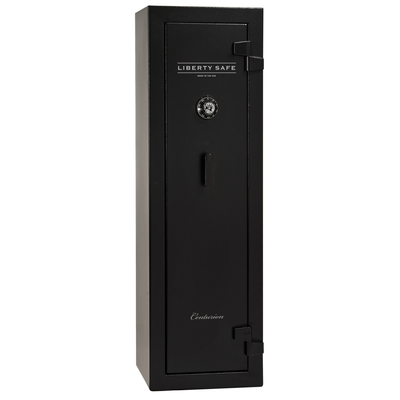
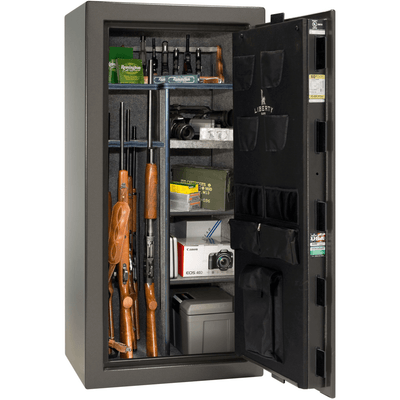
- Centurion and USA. The entry point. 14-gauge body and fire protection in the 30 to 60 minute range. Right for a first safe, a secondary safe, or basic storage that keeps firearms away from children and casual visitors. Not the choice if it's holding everything you own.
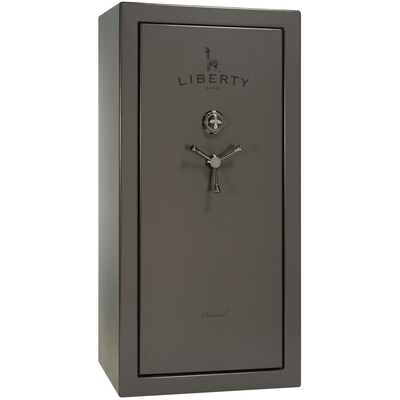
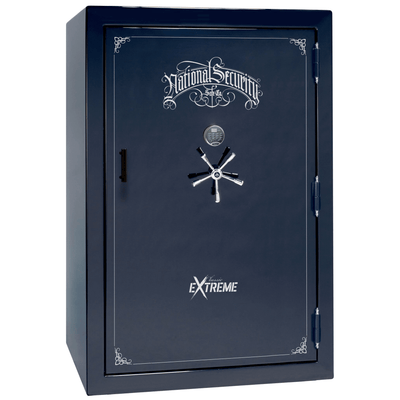
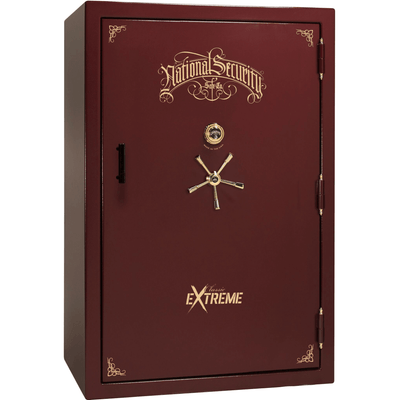
- Colonial and Franklin. The middle of the lineup and where most of our customers land. Thicker body steel, fire ratings that climb toward the two-hour mark on the Franklin, better locking hardware and more finish options. This is the value sweet spot in the Liberty catalog.
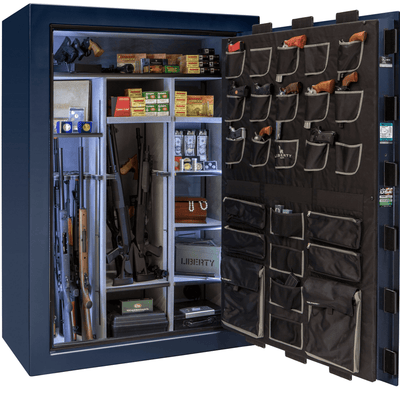
- Lincoln. Same security philosophy with the livability upgrades: interior lighting that actually works, a jewelry drawer, better shelving. Worth it when the safe holds more than firearms.
- Fatboy and Fatboy Jr. Extra width without extra height. If your collection is growing and your ceiling isn't, look here before you look at a taller safe.
- Presidential. 7-gauge steel, 150 minutes of fire protection, and the finish quality to match. It's a large purchase and a heavy one. Before you commit, have someone look at your floor and your route into the house. That's a call I make in person before we ever schedule it.
- Home and premium home safes. Smaller footprint, built for documents, cash, jewelry and a handgun or two. These are what I recommend for a closet or an office rather than a garage.
Where Liberty isn't the right pick
I'd rather you hear this from me than find out after delivery.
The Centurion line is priced to compete with big-box safes, and it's built accordingly. It's a real safe and better than a locking cabinet, but don't expect a $1,000 safe to behave like a $4,000 one.
Gloss finishes look excellent in a showroom and show every fingerprint and scuff in a garage. Textured finishes hold up far better in a working environment.
If your primary threat model is a skilled attacker with power tools and time, no residential gun safe from any brand is your answer. You're looking at a TL-rated commercial safe, which is a different product and a different budget.
And if you're in an apartment or a home where bolting into the slab isn't possible, spend the money on weight rather than on the fire rating. An unanchored 400-pound safe leaves on a furniture dolly.
The part nobody asks about: installation
This is my actual job, so allow me one section on it.
The most common serious mistake I see is a safe that was never anchored. Liberty pre-drills the floor for exactly this reason, and the hardware is inexpensive. Four bolts into a concrete slab turn a removable object into a fixed one. Every stolen-safe story I've heard locally involved a safe that wasn't bolted down.
Placement matters too. An interior wall on a ground floor is better than an exterior garage wall, because exterior walls burn through first and garages are where fires frequently start. If a safe has to live in a garage, get it off the outside wall and away from the water heater.
In our climate, humidity control is less urgent than it is in Houston or Atlanta, but it's not zero. Las Vegas garages swing from 40 degrees in January to well past 120 in August, and that cycling produces condensation on cold steel. A dehumidifier rod costs very little. Run one.
Last thing, and it's the one people don't think about until it's a problem: someone besides you needs to be able to open that safe. Combinations get lost, and the fastest way to lose access to your own property is to be the only person who knows the number.
So, are Liberty safes good?
They're good, and they're the safest default recommendation in the category. Consistent build quality, honest domestic manufacturing on the full-size lineup, a warranty that actually pays out, and a dealer network that still answers the phone a decade later.
If you're weighing a Liberty against something else, get the two safes side by side, open both doors, look at the locking bars and the door thickness, and ask what happens when something breaks in year eight. That last question tells you more than any spec sheet.
FAQ
Are Liberty safes really made in the USA?
Liberty's full-size gun safes, home safes and vault doors are built in Payson, Utah, using American steel. Not every item sold under the brand comes from that plant, so check the specific model if domestic manufacturing is a requirement for you.
How long do Liberty safes last?
The body and the lock mechanism will outlive most owners. The parts with a service life are the electronic lock, which typically needs replacement somewhere past the ten-year mark, and the fireboard, which is only compromised by an actual fire. I regularly service safes from the 1990s that are still fully functional.
Is a Liberty safe fireproof?
No safe is fireproof. Liberty safes are fire resistant, rated from roughly 30 minutes up to 150 minutes depending on the series. Gun safe fire ratings are not governed by one regulated standard across the industry, so compare the test temperature and the testing method, not just the minutes.
Does the Liberty warranty cover a stolen safe?
No. The lifetime warranty covers damage from fire and from break-ins or break-in attempts. It doesn't replace a safe that was carried off, and it doesn't cover the contents. That's what your homeowner's policy and a proper bolt-down are for.
Are Liberty safes worth the money?
For most buyers in the middle of the lineup, yes. The Colonial and Franklin ranges deliver the most protection per dollar in Liberty's catalog. At the entry level you're paying partly for the warranty and the brand's service network, which still has value. At the premium level, compare against Fort Knox before deciding.
How much does a Liberty safe weigh?
Anywhere from around 300 pounds for a small home safe to over 1,200 pounds for a large Presidential model. Weight is a security feature, and it's also the reason professional delivery matters. Check your doorways, your route, and your floor before ordering.
Can a locksmith open a Liberty safe if I forget the combination?
Yes. A qualified safe technician can open it, and depending on the method the safe may or may not need repair afterward. Keep your combination recorded somewhere secure and make sure one other person you trust can get in.
Which Liberty safe should I buy for a first gun safe?
For most first-time buyers, something in the Colonial or Franklin range at a size one step larger than you think you need. Buy for the collection you'll have in ten years, not the one you have today. That's the single most common regret I hear.
Written by